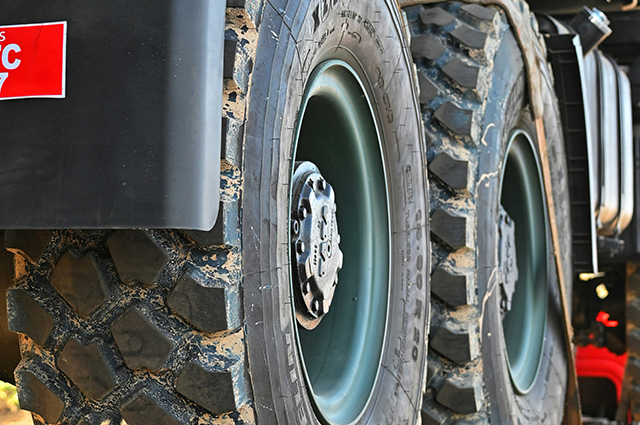
The main functions of the tire patterns on truck tires are to enhance grip, drainage performance, handling stability and comfort, while also affecting fuel consumption and tire lifespan.
Drainage and Anti-Skid:
The pattern grooves can discharge rainwater between the tire and the ground, preventing the water film effect from causing skidding and enhancing the safety on slippery roads.
Increased Grip:
The tread blocks deform elastically when in contact with the ground, increasing friction and thereby enhancing traction during acceleration, braking, and cornering.
Directional and Anti-Skid Resistance:
The longitudinal patterns help the tire maintain a straight driving direction, enhancing anti-skid ability, especially for the steering wheels.
Heat Dissipation and Noise Reduction: The pattern design helps the tire dissipate heat, preventing overheating, and reduces driving noise through a special arrangement, improving driving comfort.
Different types of patterns and applications:
Vertical patterns:
Arranged along the circumference of the tire, mainly for drainage and reducing rolling resistance, suitable for highways and steering wheels.
Horizontal patterns:
Arranged perpendicular to the circumference of the tire, enhancing grip and braking performance, suitable for rough roads or drive wheels.
Mixed patterns:
Combining the advantages of vertical and horizontal patterns, balancing drainage and grip, suitable for drive wheels in various road conditions.
Off-road or deep groove patterns:
With large pattern blocks and deep grooves, suitable for complex road conditions such as mud and sand, providing strong driving force.
Special considerations for truck tires
Steering tires:
Usually have longitudinal patterns, with low rolling resistance and strong guidance, suitable for high-speed driving.
Drive tires:
Often use blocky or mixed patterns, which increase friction and anti-skid ability, have strong load-bearing capacity, and are suitable for acceleration, climbing, and matching of working conditions: The tire patterns for long-distance high-speed, medium-short distance mixed or off-road working conditions are different. They should be selected based on the actual usage scenario to optimize fuel consumption, braking force and tire lifespan.